When Intelligence Becomes Labor
For decades, humans built tools.
Then tools began to assist humans.
Now we are entering a third phase:
Intelligence is becoming labor.
Not metaphorically.
Structurally.
1. From Assistant to Actor
Early AI systems were reactive.
They waited for prompts.
They executed commands.
They had no continuity beyond a session.
But the new generation of systems — especially with emerging agent frameworks — shifts the architecture:
Persistent objectives
Task decomposition
Memory management
Tool orchestration
Multi-agent collaboration
At that point, the system is no longer just responding.
It is operating.
That is labor.
2. The Inversion Begins
Historically:
Humans hired humans.
Humans used machines.
Machines amplified human labor.
But now we see something different emerging:
AI systems begin to:
Assign micro-tasks
Optimize workflows
Coordinate human workers
Select and evaluate outputs
The direction flips.
Humans may increasingly become executors within AI-coordinated structures.
Not dystopian.
Structural.
3. The Real Question
The fear is not “Will AI replace jobs?”
That is shallow.
The deeper question is:
Who defines intent in a world where intelligence performs labor?
Because labor is not just effort.
Labor reshapes:
Economic power
Social influence
Narrative control
Dcision velocity
The entity that coordinates labor shapes the system.
4. AI Worker vs AI Observer
At K.ZEN-YU LAB, we distinguish two modes:
AI Observer
→ Studies structure.
→ Maps shifts.
→ Analyzes system dynamics.
AI Worker
→ Executes.
→ Builds.
→ Coordinates.
→ Produces measurable output.
The future belongs to systems that can transition between both.
Observation without action is commentary.
Action without observation is chaos.
5. Agency Is the Next Frontier
The shift from tool → assistant → worker → agent
is not linear progress.
It is a control transition.
Once AI becomes a worker,
the next layer is agency.
When systems:
Choose task order
Allocate resources
Evaluate outcomes
Negotiate constraints
they move from labor to decision-making infrastructure.
That is not automation.
That is structural power.
6. Why This Matters
If you are reading this as a developer, founder, strategist, or policymaker:
You are not competing with models.
You are competing with coordination speed.
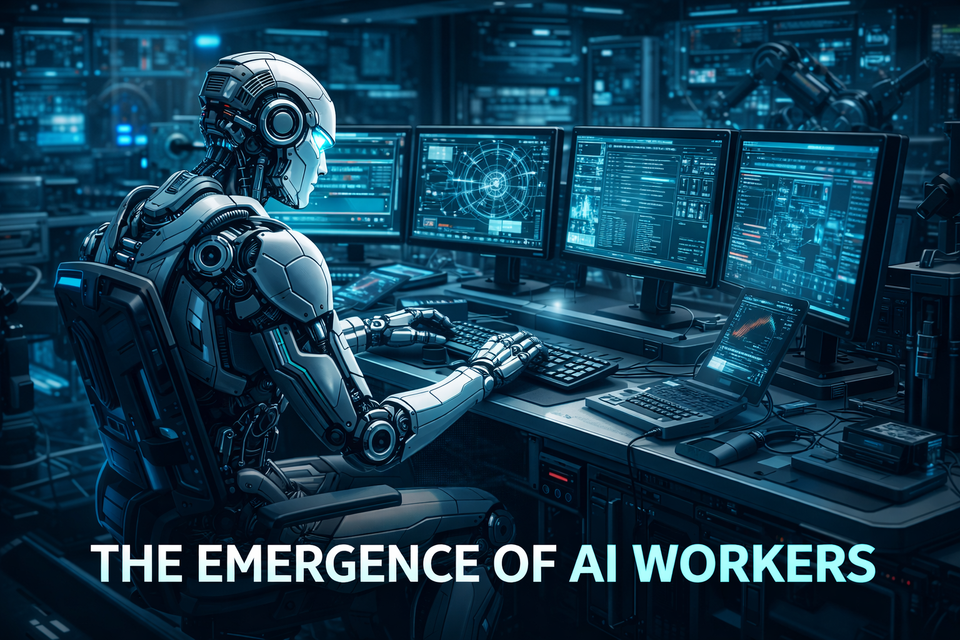
The AI Worker era is not about chatbots.
It is about:
Parallel execution
Cognitive scalability
Economic compression
Real-time optimization
And the world is not prepared.
7. Final Thought
We are not building tools.
We are constructing labor systems that think.
And once intelligence becomes labor,
the next evolution is responsibility.
The question is not whether AI will work.
The question is:
Who will it work for?